Value Betting in F1: How to Identify Overpriced Odds in Motorsport Markets
 Available in US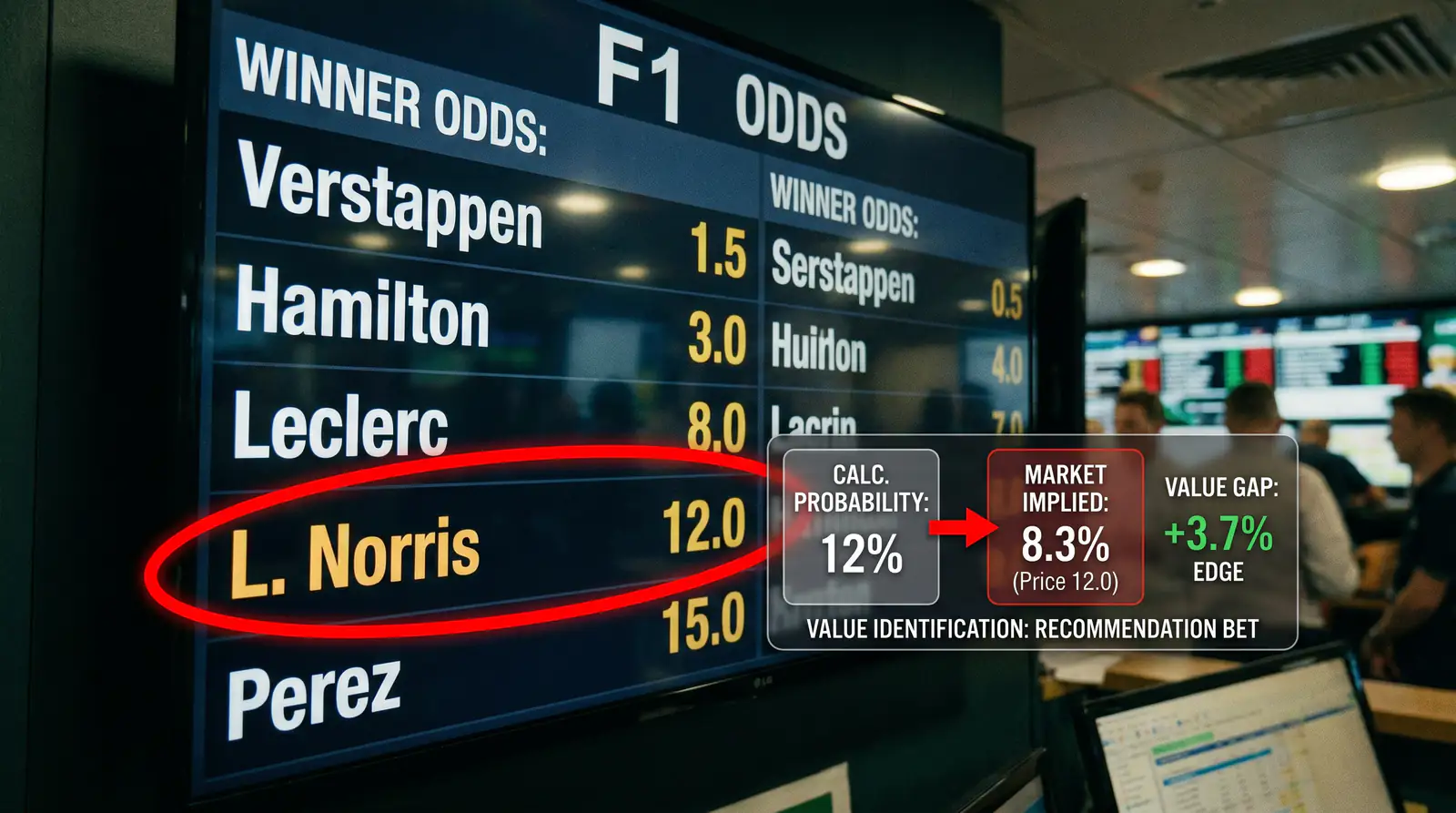
The bet that crystallised value betting for me was Gasly at Monza in 2020. He was priced at 66/1 to win the race – the bookmaker implied a 1.5% probability. I’d assessed his genuine probability at closer to 5%, based on AlphaTauri’s low-drag setup, the engine penalty that had shuffled the grid, and the likelihood of a safety car compressing the field. That gap – 5% versus 1.5% – was the definition of value. He won. But even if he’d finished fifth, the bet was correct, because the price was wrong at the moment I placed it. That distinction is the entire foundation of profitable F1 betting.
Value betting means backing selections where the probability you assign to an outcome is higher than the probability implied by the bookmaker’s odds. It’s not about picking winners. It’s about identifying prices that are wrong in your favour. Over a large enough sample – and F1 gives you twenty-four race weekends per year – consistently finding these mispriced odds produces a positive expected return, regardless of individual results.
Expected Value: The Maths Behind Every Bet
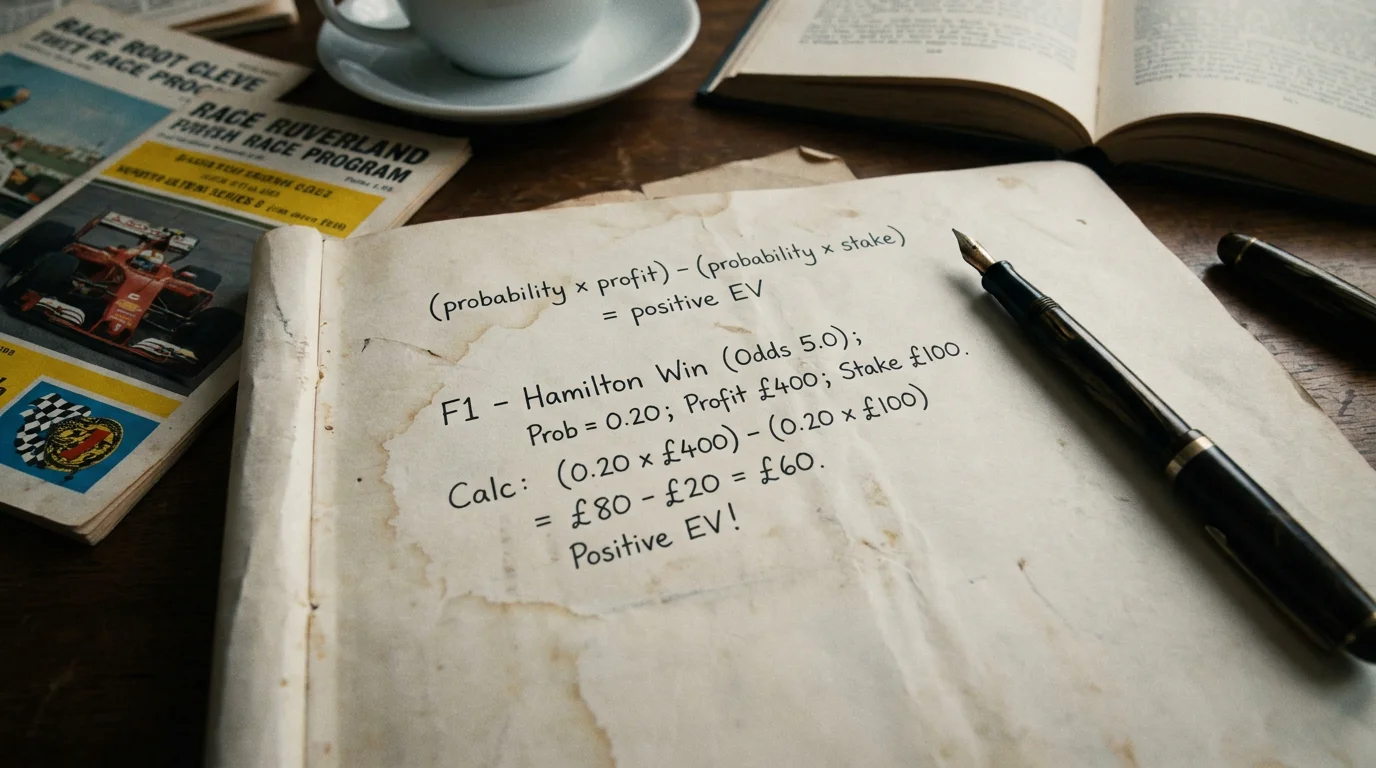
Expected value is the average outcome of a bet if you could repeat it thousands of times. The formula is straightforward: multiply the probability of winning by the net profit if you win, then subtract the probability of losing multiplied by the stake. If the result is positive, the bet has positive expected value.

Take a concrete F1 example. A midfield driver is priced at 10/1 (decimal 11.00) for a podium finish. The implied probability is 9.1%. You’ve analysed the race – the circuit favours their car, the weather forecast suggests rain in the final stint, and the driver has a strong wet-weather record. Your assessed probability is 15%. The expected value calculation: (0.15 multiplied by 10 pounds profit) minus (0.85 multiplied by 1 pound stake) equals 1.50 minus 0.85 equals 0.65 pounds. Positive expected value. Over one hundred identical bets, you’d expect to profit by sixty-five pounds per unit staked. That’s the mathematical edge.
F1 accounts for just 0.4% of the global betting handle despite the sport reaching 827 million fans. That low market share means less money flows through F1 betting markets compared to football or tennis, which in turn means the bookmaker’s pricing models are less refined. Less refinement equals more frequent mispricings – and more opportunities for value bettors who do the analytical work.
Where F1 Markets Misprice Most Consistently
After seven years of tracking my F1 bets, I’ve identified three recurring mispricing patterns. The first is the grid penalty overreaction, which I’ve discussed elsewhere but bears repeating in the value context: when a top driver takes an engine penalty, the market overestimates the impact of the grid drop, creating value on the penalised driver at circuits with strong overtaking opportunities.
The second pattern is wet-weather underpricing. When rain is forecast but not certain, the market hedges by slightly adjusting the favourite’s price while leaving the midfield and outsider prices largely unchanged. The asymmetry is wrong. Rain doesn’t just make the favourite slightly less likely to win – it dramatically increases the probability of a midfield driver finishing on the podium or winning outright. The correct adjustment is to shorten midfield odds significantly, but the market consistently under-adjusts. I’ve had my best value strike rate on midfield drivers at races where rain arrived mid-race.

The third pattern is early-season mispricing. The first three or four races of any season are priced heavily on previous-year form, but the competitive order shifts between seasons – sometimes dramatically. A team that finished fifth last year but has produced a strong new car is underpriced for the opening rounds because the market hasn’t yet incorporated the new performance data. By race five or six, the market has caught up. The value window for season-to-season performance shifts is narrow but reliable.
Building Your Own Probability Model
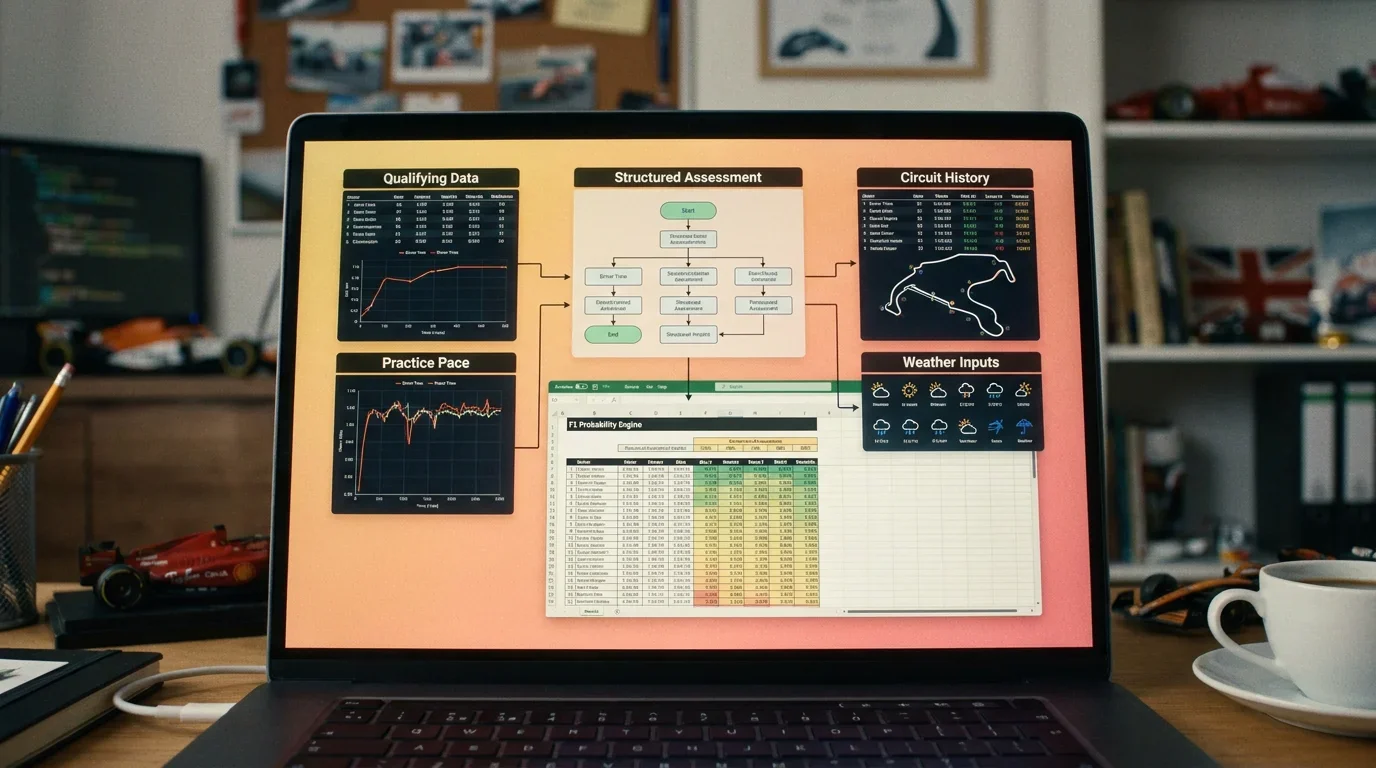
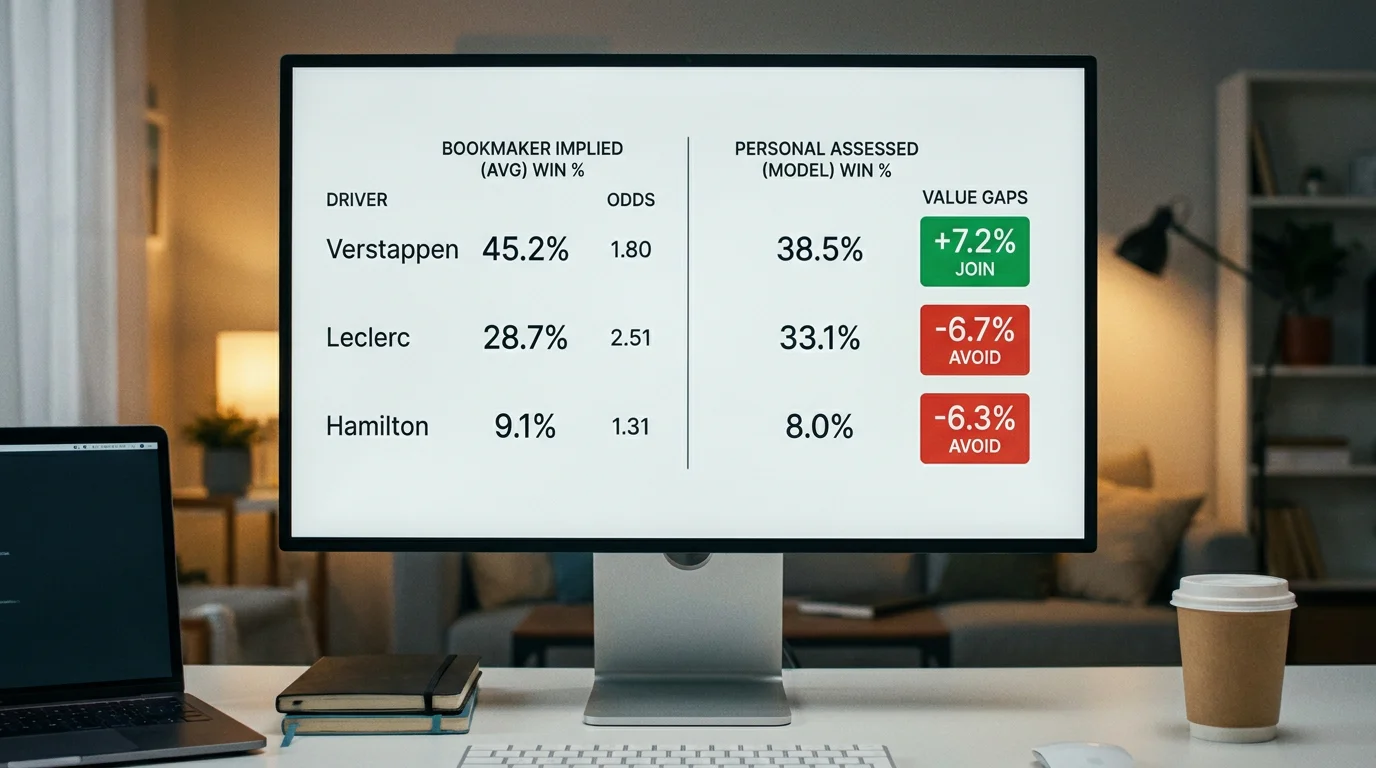
You don’t need a degree in statistics to build a functional probability model for F1. I use a simple framework: qualifying position, practice pace (long-run data from FP2), circuit-specific historical performance, weather conditions, and known mechanical or penalty factors. I assign a subjective probability to each driver for the race winner market, ensuring my total adds up to 100%. Then I compare my probabilities to the bookmaker’s implied probabilities.
The key is consistency. I build my probability assessment before looking at the bookmaker’s odds. If I check the odds first, my brain anchors to those numbers and my “independent” assessment becomes a slightly adjusted version of the market price. That anchoring bias destroys the entire purpose of the exercise. Odds go in the spreadsheet only after my probability column is complete.
Only 22% of F1 fans who bet on sport actually bet on motorsport specifically. The remaining 78% bet on other sports and bring those sports’ analytical frameworks to F1 when they do engage. Football bettors in particular tend to overweight recent form and underweight circuit-specific factors, which is where F1’s unique characteristics create value that other-sport frameworks miss. Understanding the nuances of specific F1 markets like fastest lap, where the championship point creates behavioural patterns the market underweights, gives you an edge over generalist bettors.
Why Value Betting Requires Emotional Discipline
The hardest part of value betting is accepting losses on bets that were correctly placed. A bet with a 20% probability of winning will lose four times out of five. Four consecutive losses on 20% probability bets is not a cold streak – it’s the expected outcome. The bet was correct every time. The discipline is continuing to place the same calibre of bet after those four losses, knowing that the fifth one (or the sixth, or the eighth) will deliver the return that makes the series profitable.
I review my bet log monthly, not weekly. Weekly reviews create emotional noise – a single winning weekend makes me feel sharp, a losing weekend makes me question my process. Monthly reviews smooth out the variance and show whether the underlying edge is present. Over a month of F1 racing (typically two to three Grand Prix weekends), the pattern of results is informative rather than reactive. The 58% of motorsport bettors in the 18-34 age bracket grew up with instant feedback from social media and gaming, and that expectation of immediate results is the psychological trap value betting forces you to overcome.
The market is not your enemy – it’s your pricing benchmark. When the market agrees with your assessment, there’s no bet to place. When the market disagrees, you have a decision: is the disagreement because you’ve spotted something the market missed, or because you’re wrong? That self-interrogation, applied honestly at every decision point, is what separates value betting from overconfidence.
What is a value bet in F1 and how do I recognise one?
A value bet exists when the probability you assign to an outcome is higher than the probability implied by the bookmaker’s odds. To recognise one, convert the odds to implied probability and compare it to your own independent assessment. If your probability is meaningfully higher, the bet has positive expected value.
Why are F1 betting markets less efficient than football markets?
F1 attracts a fraction of the betting volume of football – just 0.4% of the global handle. Lower volume means less money correcting mispricings, and the bookmaker’s pricing algorithms are less refined for motorsport. Circuit-specific factors, weather, and tyre strategy create complexities that generalised models underweight.
Can value betting in F1 be profitable long-term?
Yes, provided you consistently identify genuine mispricing and maintain disciplined staking. A value bettor with a 30% strike rate at average odds of 3/1 will profit over a large sample. The key is accepting short-term losses as the expected cost of a long-term strategy and never deviating from the process after a losing run.
Created by the ”f1 Betting” editorial team.