F1 Outright Betting: Season-Long Markets and When to Lock In Championship Odds
 Available in US
I locked in a championship outright on Max Verstappen before the 2023 season at 4/6. Boring, safe, and profitable – but I left money on the table. A friend who waited until after the Azerbaijan Grand Prix, when Sergio Perez had closed the points gap, got Verstappen at 4/5 because the market briefly panicked. That taught me the most important lesson in outright F1 betting: timing isn’t about being first, it’s about being right about when the market is wrong.
Outright betting – also called ante-post or futures betting – means placing a wager on an outcome that won’t be decided until the end of the season. In F1, this primarily covers the Drivers’ Championship and the Constructors’ Championship winners, though some bookmakers also offer markets on which driver finishes in the top three overall or which team secures a specific championship position. These bets can be placed months before the season starts and remain open throughout the campaign, with odds shifting after every qualifying session, race, and regulation announcement.

Ante-Post F1 Bets: Rules, Refunds and Dead-Heat Scenarios
I once had a mate lose an outright bet because the driver he’d backed switched teams mid-season and the bookmaker’s ante-post rules explicitly stated no refunds for driver transfers. That experience hammered home a point I now repeat to everyone: read the ante-post terms before you place the bet, not after something goes wrong.
Ante-post rules in F1 are stricter than most punters expect. The critical difference between an ante-post bet and a standard race-day bet is that ante-post selections are typically non-refundable. If your driver retires from the sport, gets injured, or is dropped by their team before the season ends, your stake is lost in most cases. Some bookmakers have started offering “non-runner, money back” terms on selected championship markets, but this remains the exception rather than the rule for pre-season bets.
Dead heats in championship betting are theoretically possible but have never occurred in the modern points system. If two drivers finished level on points, countback procedures (most wins, then most second places, and so on) would determine the champion. Bookmakers generally state that if the official FIA classification declares a winner, that result stands for settlement purposes. The global F1 fanbase hit 827 million in 2025, a 63% increase since 2018, and with that surge in interest has come a corresponding expansion of outright market depth – more operators now offer top-three championship finish markets, relegation-style “bottom team” bets, and margin-of-victory specials.
Voided bets on outrights are rare but can occur if the championship is abandoned or if a fundamental rule change invalidates the market. In practice, this has never happened in the modern era. Bookmakers settle on the official FIA Drivers’ and Constructors’ Championship standings as published after the final race of the season, including any post-event penalties or disqualifications applied before the results are declared final.
When Championship Odds Offer the Most Value During a Season
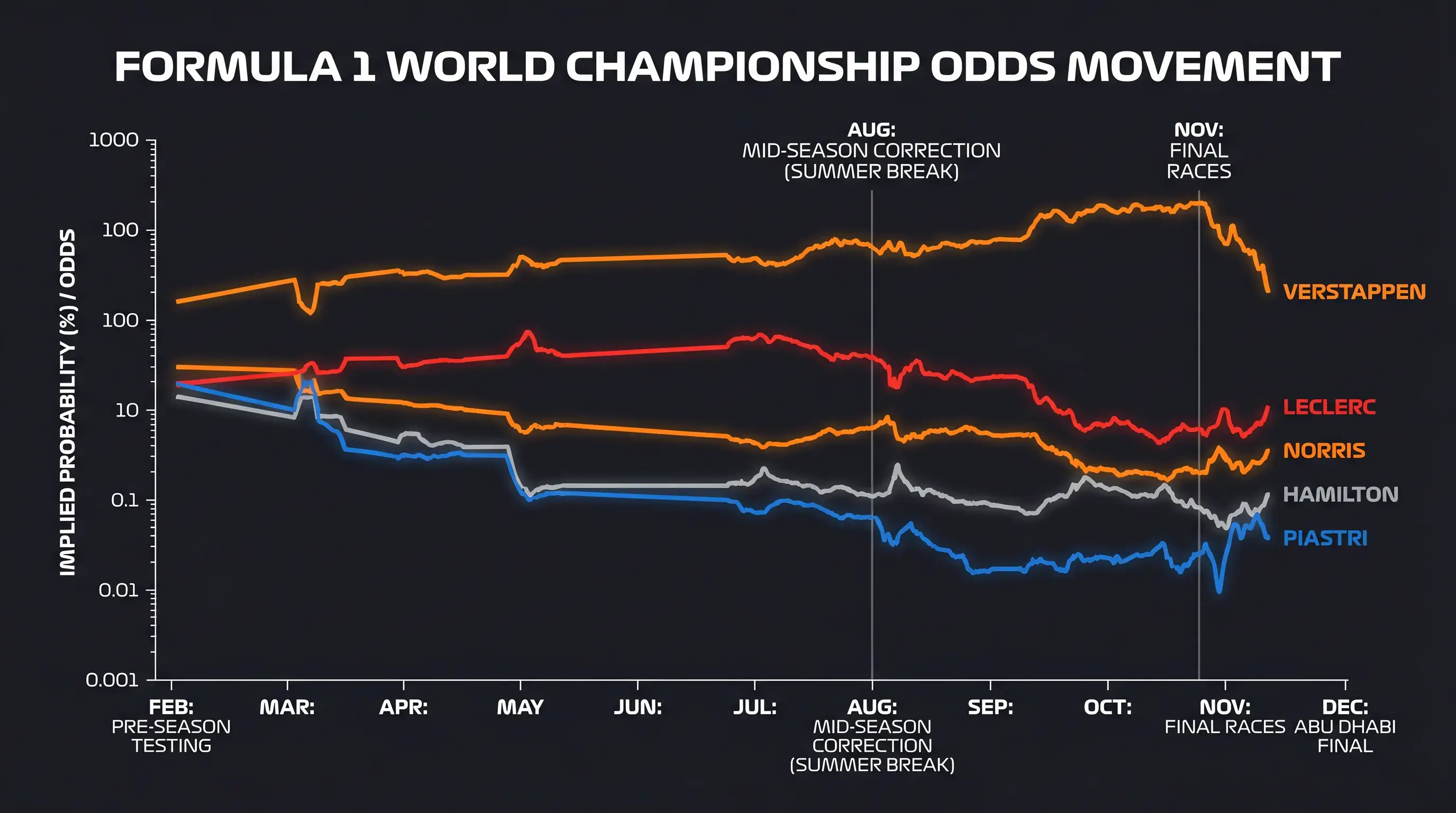
The pre-season window is where most casual punters place their outrights, and it’s often where they get the worst prices. I’ve tracked outright odds movement across four consecutive seasons, and the pattern is consistent: the market overreacts to pre-season testing narratives and underreacts to early-season race data. The best value windows tend to open after the first three or four races, when actual performance data starts contradicting pre-season assumptions.
The 2025 season saw a record 6.7 million total attendance across 24 races, with 19 of those rounds selling out entirely. That explosion of interest has made the outright markets deeper and more liquid, which is good for punters – it means bookmakers are more willing to offer competitive prices and take larger bets on championship outcomes. But it also means the market corrects faster. A bad qualifying session at the opening race used to move championship odds for days. Now it corrects within hours.

My approach is to identify two or three value windows through the season. The first comes during pre-season testing when hype inflates the odds on underperforming teams and compresses the favourite’s price too aggressively. The second window opens after the first flyaway races, when a contender’s early results disappoint and the market drifts their price beyond what the underlying pace data justifies. The third window – the one my friend exploited – appears mid-season when a challenger strings together strong results and the market overcorrects on the favourite.
I never place my entire outright allocation in one go. I split it across these windows, scaling in at different prices. This averaging approach means I rarely get the best single price, but my average entry is consistently better than any one-shot punt would deliver. The constructors’ championship market follows a similar rhythm but with an added variable: mid-season upgrades can dramatically shift a team’s relative performance in ways that the drivers’ market doesn’t fully capture.

How Mid-Season Regulation Changes Shift Outright Odds
The 2026 season represents a regulation reset – new engine formulas, revised aerodynamic rules, and updated sporting regulations. These shifts don’t just change how the cars look; they scramble the competitive order in ways that make pre-season outright pricing little more than educated guessing. I’ve seen regulation years produce championship outcomes that no bookmaker had anywhere near the front of their pre-season pricing.
Technical directives issued mid-season are the hidden variable that most outright bettors ignore. The FIA has increasingly used technical clarifications to address performance advantages that specific teams exploit. A directive that changes floor flexibility rules or limits a particular cooling solution can swing multiple tenths of a second per lap – enough to reshape the championship picture entirely. These directives are often telegraphed weeks before they take effect through paddock reporting, which gives attentive punters a head start on the market.
Budget cap complications add another dimension. If a team exceeds the cost cap, the penalties – reduced wind tunnel time, development restrictions, or point deductions – directly affect championship odds. I monitor the financial reporting deadlines because the market tends to move on rumours of cost cap breaches before the FIA’s formal adjudication. The period between a rumoured breach and the official ruling is a window where outright odds on the affected team’s drivers can offer disproportionate value if you believe the penalty will be lenient, or conversely, the competitor’s odds may be too long if you expect a harsh sanction.
My rule for regulation years is simple: underweight pre-season confidence, overweight early-race data, and keep dry powder for the mid-season correction that regulation changes almost always produce. The teams that get the new rules right from day one aren’t always the teams that have the best package by race twelve. Convergence is real, and the outright market rarely prices it in adequately.
What happens to my outright F1 bet if a driver switches teams mid-season?
Under most bookmakers’ ante-post rules, your bet stands regardless of team changes. If the driver you backed moves to a different team or is replaced, your stake is not refunded. Some operators offer non-runner money-back terms on selected markets, but this must be confirmed before placing the bet.
Can I cash out an F1 championship futures bet?
Most major UK bookmakers offer cash out on F1 outright markets, though the availability and value fluctuate based on current championship standings and remaining races. Cash-out values are typically lower than the theoretical value of the bet because bookmakers apply a margin to the offer.
When is the best time to place an F1 outright bet – pre-season or mid-season?
Neither is universally better. Pre-season prices can offer value when the market overestimates or underestimates a team’s readiness. Mid-season windows open when results temporarily contradict a driver’s true pace. Splitting your outright allocation across multiple entry points usually produces a better average price than a single punt.
Written by the editors at f1 Betting.