F1 Points Finish Betting: Finding Value in the Top Ten
 Available in US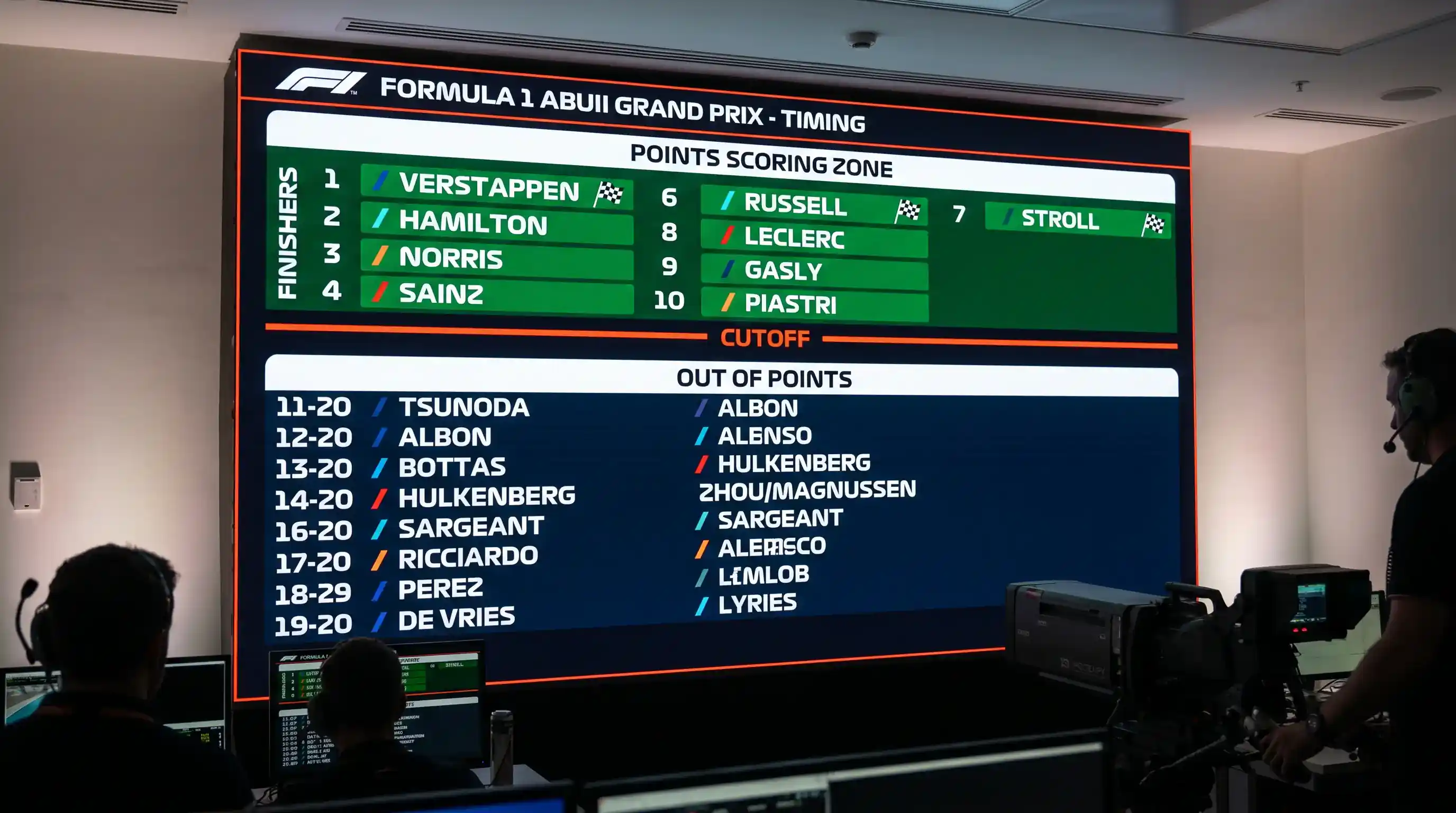
I once backed a midfield driver at 5/2 to finish in the points at Monza. He started twelfth, got swallowed up at the first chicane, dropped to sixteenth, and spent thirty laps fighting back through the field. Tenth on the final lap – one point, and my bet landed by a margin of about two tenths of a second from the car behind. Points finish betting lives in that narrow space between comfortable podium markets and chaotic retirement bets, and it’s where I find some of the most consistent value across a season.

A points finish in F1 means completing the race inside the top ten. The current points system awards positions one through ten (25-18-15-12-10-8-6-4-2-1), plus the fastest lap bonus point for a driver already in the top ten. For betting purposes, only the finishing position matters – whether the driver scores one point or twenty-five, the bet settles the same way. That binary outcome – top ten or not – makes it a clean market to analyse.
Why the Top Ten Is the Sweet Spot for Midfield Value
F1’s fanbase has hit 827 million globally, with 43% of those fans under the age of 35. That younger demographic gravitates toward markets they can understand quickly, and “will this driver finish in the top ten” is about as straightforward as it gets. But simplicity in the question doesn’t mean the odds are efficiently priced.
The F1 grid has twenty cars. In a clean race with few retirements, finishing in the top ten means beating exactly half the field. The average retirement rate of two to four cars per race means the effective field is often sixteen to eighteen cars, which shifts the baseline probability of a random car finishing in the top ten from 50% to roughly 55-62%. That baseline matters because bookmakers don’t always fully adjust the midfield drivers’ odds for expected retirements. A driver who qualifies fourteenth but whose true probability of finishing tenth or better – accounting for retirements, safety car strategies, and first-lap position gains – is 45% might be priced at odds that imply only 35%. That gap is your edge.

The drivers where this value concentrates are those in the seventh-to-twelfth qualifying positions. They’re fast enough to run in or near the top ten on pace alone, and any disruption to the cars ahead – a retirement, a botched pit stop, a safety car timing advantage – pushes them into the points. I track each driver’s qualifying-to-race position delta across the season. Some drivers consistently gain positions on Sunday relative to their Saturday qualifying. Those consistent improvers are underpriced in the points finish market almost every race weekend.
Circuit Characteristics That Shift Points Finish Probabilities
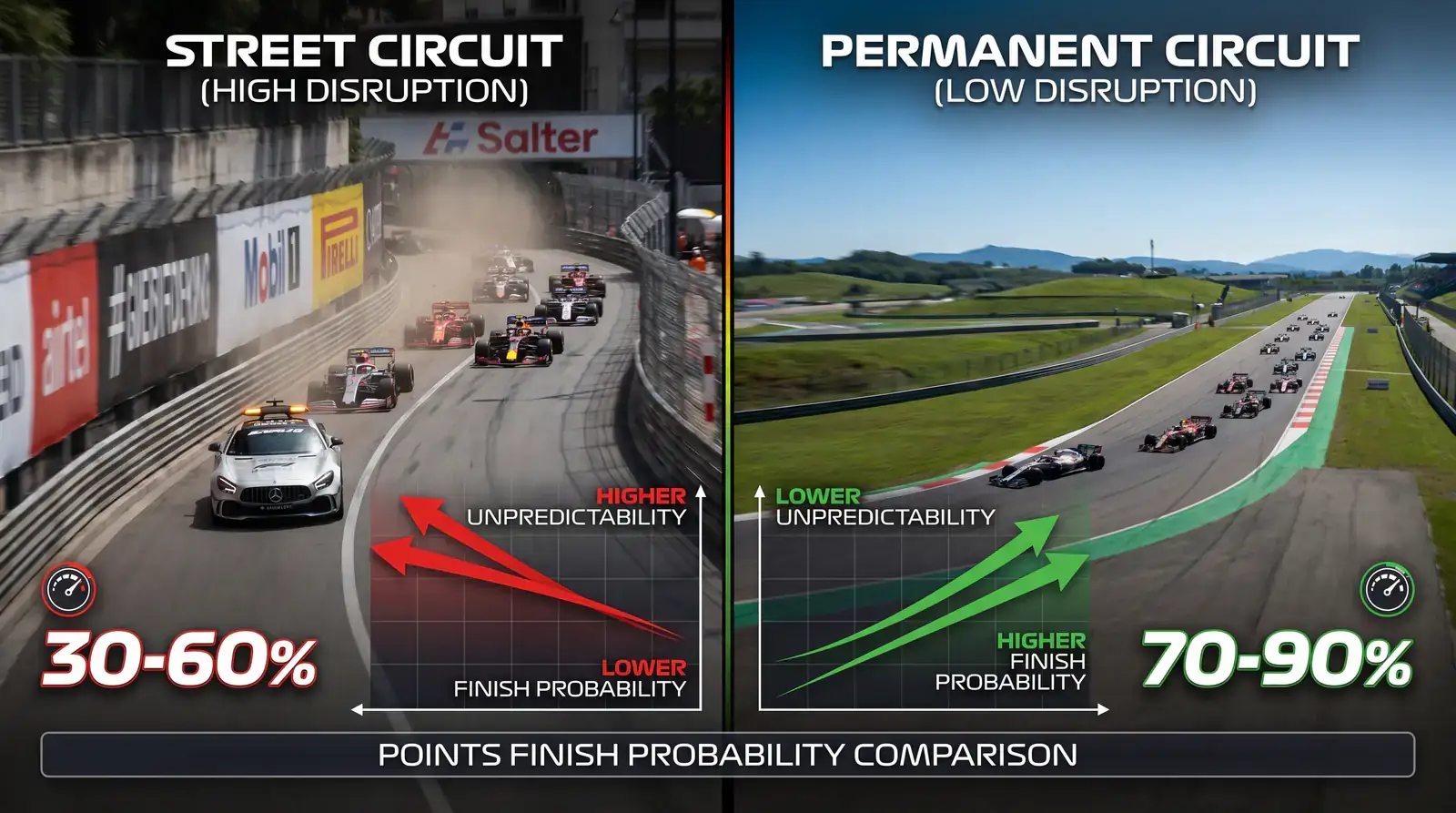
Not all tracks create equal points finish opportunities. At Monaco, where overtaking is nearly impossible, the top ten in qualifying almost always mirrors the top ten at the finish. Midfield drivers who qualify outside the top ten have a realistic path to the points only through retirements or strategic gambles. The points finish market at Monaco is tightly priced and offers little value on outsiders.
Contrast that with a circuit like Bahrain or Spa, where overtaking opportunities are plentiful and tyre degradation creates strategic diversity. At these venues, a driver starting fifteenth can realistically race into the top ten on pure pace combined with a well-timed pit stop. The points finish odds on midfield drivers at high-overtaking circuits tend to be more generous because the bookmaker weights the qualifying position heavily, but the race dynamics significantly favour position changes.

I categorise each race on the calendar into three buckets: low-variance (Monaco, Hungary, Singapore – where qualifying position strongly predicts race finish), medium-variance (most permanent circuits with reasonable overtaking), and high-variance (wet-weather races, first races at new venues, and tracks with high degradation). My staking reflects these categories: I bet more aggressively on points finish markets at high-variance events, where the implied probability from bookmakers’ odds most consistently underestimates actual finishing probability for midfield runners.
Combining Points Finish Bets with Other Markets
Where points finish betting becomes genuinely powerful is as a component within a broader race-day strategy. I rarely bet on points finish in isolation. Instead, I use it as a hedge or a complement to higher-variance bets on the same driver. If I’ve backed a midfield driver for a podium finish at long odds, I’ll sometimes also take them to finish in the points at much shorter odds. The podium bet is the home run; the points finish bet is the base hit that recovers my stake if the driver finishes seventh instead of third.
The each-way approach works on similar principles, but points finish bets give you explicit control over the place leg. With each-way, the bookmaker sets the place terms and the fraction. With a dedicated points finish bet, you choose the odds and the stake independently. That control is worth a slightly lower potential payout.
Season-long points finish accumulators are another avenue I explore sparingly. Selecting three midfield drivers to all finish in the points across a single race weekend creates a short accumulator at reasonable prices. The correlation between selections is low – one driver’s result doesn’t strongly influence another’s – which means the accumulator pricing doesn’t carry the same hidden margin as, say, a football accumulator where results are more correlated. Three points-finish selections at odds around 6/4 each produce an accumulator at roughly 13/1, and the true probability of all three landing is higher than those odds imply at high-variance events.
When Points Finish Bets Don’t Make Sense
The market has limits. Backing a front-running driver – the championship leader or a driver at a dominant team – to finish in the points is almost never worthwhile. The odds are prohibitively short, often 1/20 or worse, and the only scenarios where you lose are retirement and disqualification. You’re accepting enormous downside risk for negligible return. The 58% of motorsport bettors aged 18 to 34 are sharp enough to recognise this, and the money flows accordingly toward midfield selections where the pricing carries genuine uncertainty.
Backmarker drivers present the opposite problem. A driver at the slowest team on the grid, consistently qualifying nineteenth or twentieth, needs multiple retirements ahead just to approach the top ten. The odds might look attractive at 4/1 or 5/1, but the underlying probability is often lower than those odds suggest once you account for the team’s own reliability issues. The value window sits in the middle of the grid – drivers with the pace to be near the points on merit and the fortune to benefit from any disruption ahead.
What counts as a points finish in F1 for betting purposes?
A points finish means the driver is classified inside the top ten in the official FIA race results. The current scoring system awards points to positions one through ten. For betting purposes, the driver must appear in the top ten of the official classification – post-race penalties and disqualifications can affect settlement.
Are points finish bets good value compared to podium or race winner bets?
Points finish bets offer lower payouts but higher strike rates. They work best for midfield drivers who qualify between seventh and twelfth, where the probability of finishing in the top ten is higher than the bookmaker’s odds imply. For front-runners, the odds are too short to offer meaningful value.
Written by the editors at f1 Betting.