F1 Each-Way Betting: How Place Terms Work and When the Value Appears
 Available in US
I placed my first each-way bet on F1 back in 2019 – a punt on Carlos Sainz at Monza that paid out the place leg at a quarter of the win odds. That single bet taught me more about each-way value than months of reading theory. The win part lost, but the place part returned a decent profit because I understood the terms before I clicked “confirm.” Most punters I talk to skip each-way entirely because they don’t realise how generous the place terms can be in a 20-driver field.
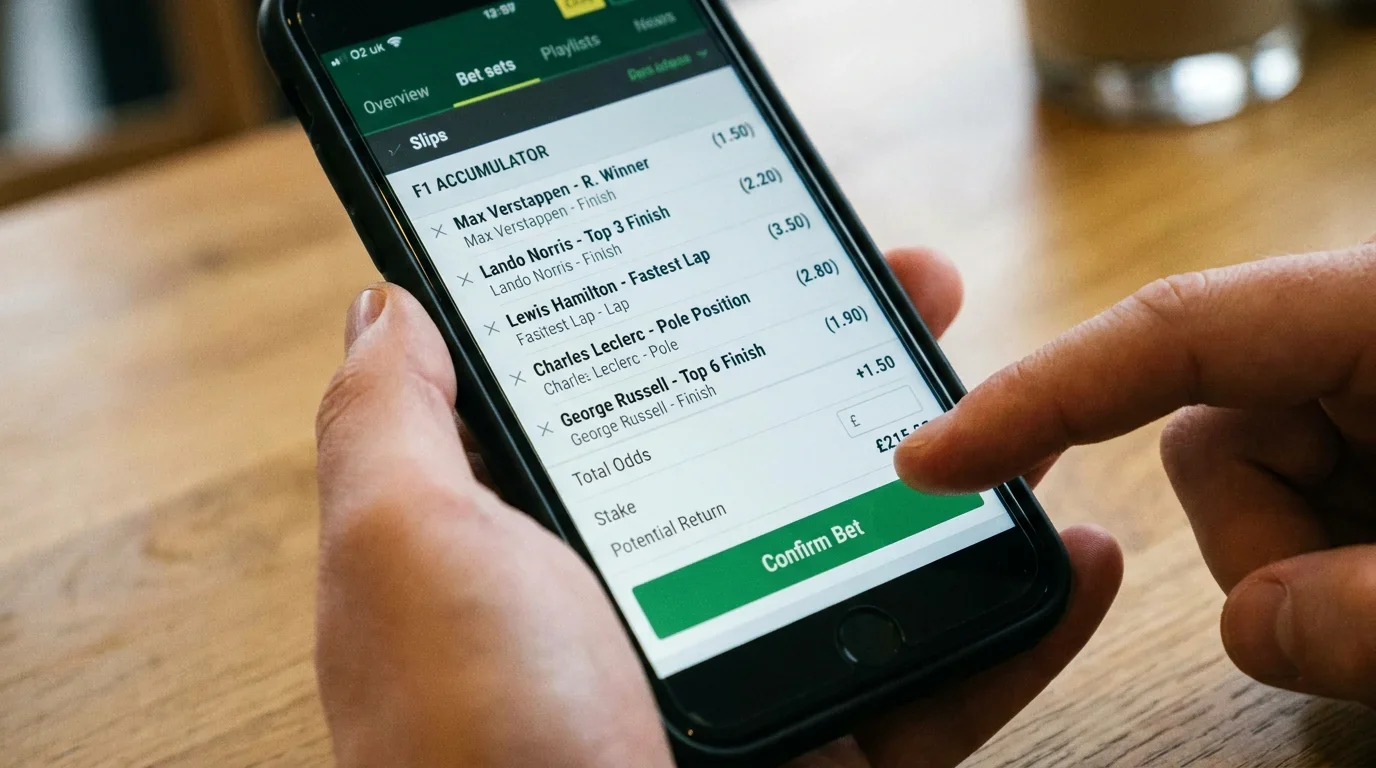
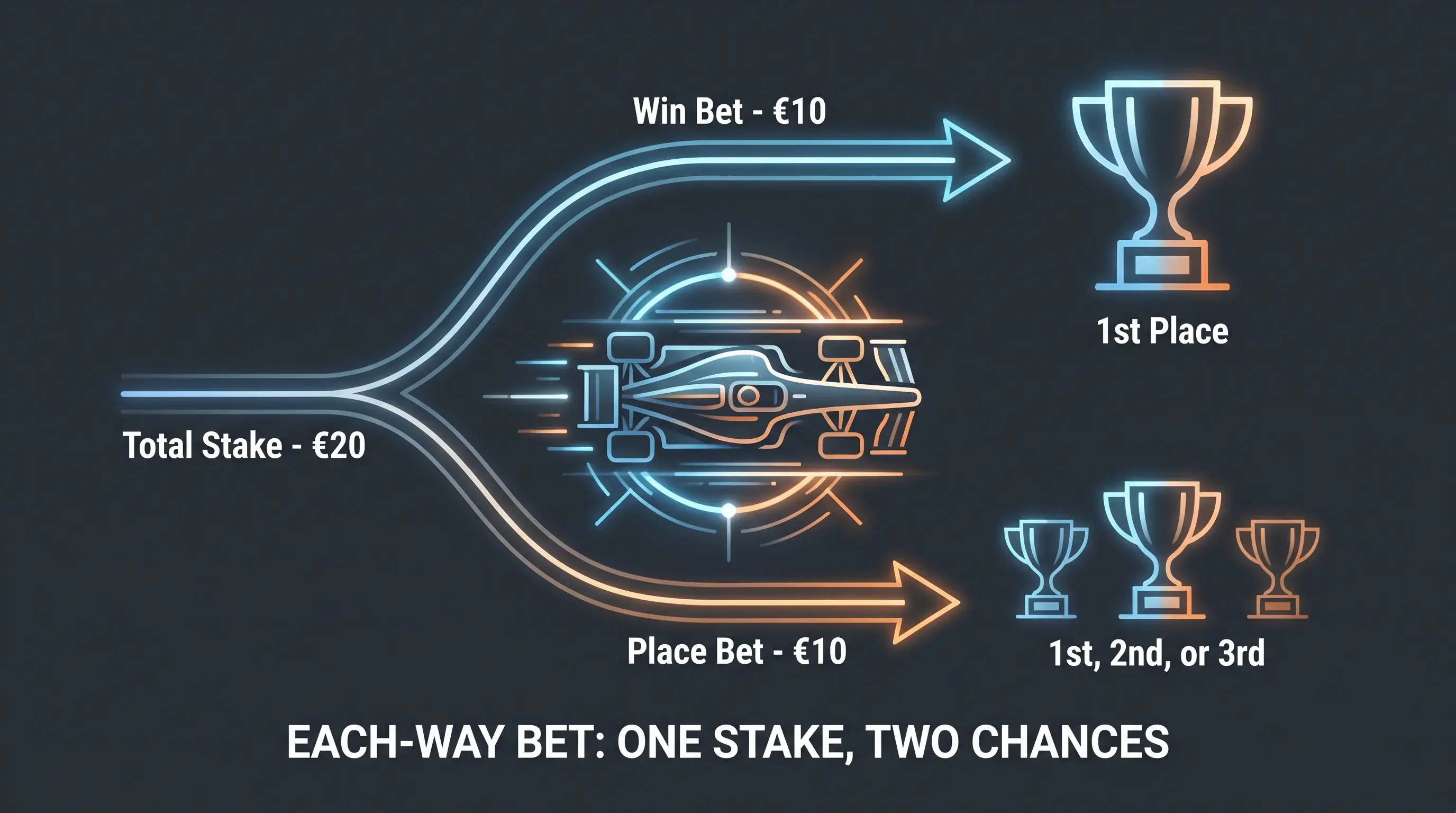
Each-way betting splits your stake into two separate bets: one on the driver to win outright, and one on the driver to finish within the bookmaker’s place terms. In F1, with fields of 20 runners, those place terms typically cover the top three or sometimes the top four. Your total outlay is double your unit stake – so a “ten pounds each way” costs twenty pounds. If the driver wins, both legs pay out. If the driver finishes inside the place terms but doesn’t win, only the place leg returns money. The place odds are a fraction of the win odds, usually a quarter or a fifth depending on the operator.
F1 accounts for just 0.4% of the global betting handle, a number that surprises people given the sport’s 827 million fans worldwide. That gap between audience size and betting volume means the each-way markets are less refined than, say, horse racing – and less refinement creates opportunities for punters who do the work.
How Each-Way Betting Works in Formula 1
I remember explaining each-way to a friend during the 2023 Monaco Grand Prix. He thought it was a single bet on a podium finish. That misconception is everywhere, so let me be precise. An each-way bet is two bets in one: the win bet and the place bet. Both run independently against the same selection. The place fraction – the portion of the win odds you receive for a place finish – varies by bookmaker and sometimes by race.
In a standard 20-runner F1 Grand Prix, most UK bookmakers offer place terms of 1/4 odds for the first three places. Some extend this to 1/5 odds for the first four places. That distinction matters enormously to your expected return. Take a driver priced at 16/1. With 1/4 odds and top-three terms, the place leg pays 4/1. With 1/5 odds and top-four terms, the place leg pays 16/5 (3.2/1) but covers an extra finishing position. The second option has a higher probability of triggering but a lower payout per unit.
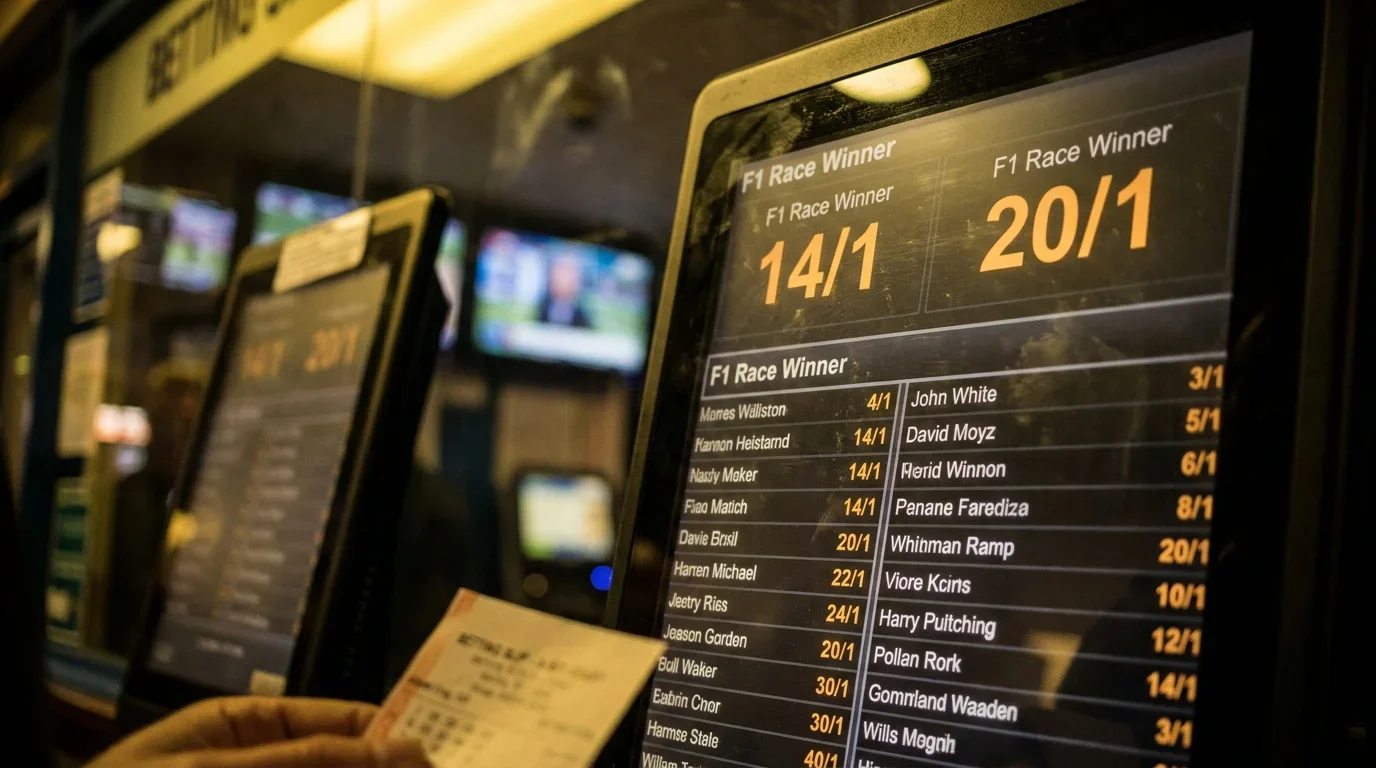
Here’s a concrete example. You bet ten pounds each way on a midfield driver at 20/1. Total outlay: twenty pounds. If that driver finishes second, your win bet loses, but your place bet at 1/4 of 20/1 pays 5/1 on your ten-pound place stake – fifty pounds returned plus your ten-pound stake, totalling sixty pounds. Subtract the twenty-pound total outlay and your profit is forty pounds. If the driver wins, both legs pay: 200 pounds from the win leg plus 50 from the place leg, plus both stakes back. That’s a 270-pound return on a twenty-pound outlay.
Settlement is straightforward in most cases. Bookmakers settle on the official FIA classification issued after the podium ceremony, though post-race penalties applied before the results are declared official can alter the outcome. If a driver crosses the line in fourth but gets promoted to third after a time penalty is applied to another car, your place bet wins – provided the bookmaker settles on the official classification, which almost all UK operators do.
Place Terms Across UK Bookmakers for F1 Races
Not all place terms are created equal, and I’ve learned this the hard way by not checking before placing. The place fraction and the number of places offered are the two variables that determine whether an each-way bet has any mathematical edge. A bookmaker offering 1/4 odds for three places gives you a fundamentally different proposition than one offering 1/5 for four places.
The standard across most UK-licensed operators for a full-grid F1 race is three places at 1/4 the win odds. Some operators increase the places to four for selected high-profile races – the British Grand Prix at Silverstone, for instance, sometimes gets enhanced each-way terms as a promotional gesture. A handful of bookmakers offer 1/5 odds for five places on selected events, though this has become less common in 2026.

What I always check is the interplay between the fraction and the places. Three places at 1/4 odds often provides better expected value on shorter-priced selections because the higher fraction compensates for covering fewer positions. Four places at 1/5 odds tends to favour longer shots – drivers priced at 25/1 or above – because the additional place covered increases the probability of a return enough to offset the lower fraction. I keep a simple spreadsheet that calculates the implied probability of each-way value based on both sets of terms, and it consistently shows that the optimal strategy shifts depending on the driver’s price range.
Sprint races complicate matters. With fewer laps and less strategic variation, some bookmakers reduce their place terms to two places for sprint events. Always verify the terms before placing, especially during sprint weekends when the standard assumptions don’t apply.
When Each-Way Offers Better Expected Value Than Win-Only
The question I get asked most often: when should I bet each-way instead of win-only? My answer is blunt – each-way only makes sense when the place leg alone carries positive expected value. If the place odds, after the fraction is applied, imply a probability lower than your assessed probability of the driver finishing in the place terms, the bet has mathematical justification.
Twenty-eight percent of F1 fans placed an online sports bet in the last twelve months – the highest propensity of any major sports fanbase. Yet many of those bettors default to win-only bets without considering each-way, missing a structural advantage that F1’s field size provides. In horse racing, a 20-runner handicap gets similar each-way attention to what an F1 Grand Prix deserves but rarely receives.
Here’s where the value typically appears. Midfield drivers priced between 10/1 and 33/1 offer the sweet spot for each-way in F1. At these odds, the place leg pays between 2.5/1 and 8.25/1 at quarter-odds terms. A driver at 20/1 has an implied win probability of roughly 4.8%, but their implied place probability is considerably higher – often in the 20-30% range when you account for the likelihood of retirements, safety car interventions, and strategy variance. If your own assessment of a podium finish sits above the implied probability of the place odds, you have a value each-way bet.
Conversely, each-way on short-priced favourites – drivers at 2/1 or shorter – is almost always a losing proposition. The place leg at 1/2 or less requires the driver to finish on the podium just to break even on that half of the stake, and the probability is already priced into the market efficiently. Win-only is the cleaner bet at the short end of the market.
The races where each-way value concentrates are the ones with high variance: wet weekends, street circuits with a history of safety car deployments, and races where the top teams have shown inconsistent pace through practice. These are the Grand Prix weekends where I allocate a larger share of my bank to each-way selections. The full range of F1 betting markets includes several options that complement each-way thinking, particularly podium finish and top-six finish bets that function on similar logic but with different payout structures.
The Season-Long Each-Way Approach
One thing I’ve learned over seven years of betting on F1 is that each-way is not a race-by-race tactic – it’s a season-long framework. With 24 races on the 2026 calendar, the variance of individual race outcomes averages out over enough events. A midfield driver who finishes on the podium three or four times across a season can deliver a positive return on a consistent each-way strategy even if the other twenty bets lose.
I track my each-way strike rate separately from my win-only bets. The place hit rate on drivers between 12/1 and 25/1 in my records sits around 18% over the past three seasons – comfortably above the break-even threshold for quarter-odds three-place terms at those prices. That doesn’t guarantee future results, but it demonstrates that the structural features of F1 – unpredictable safety car periods, strategy divergence, mechanical failures among frontrunners – create a consistent edge for each-way punters who select their spots carefully.

Staking discipline matters here more than with win-only bets. Because each-way doubles your outlay, it’s easy to overextend. I allocate no more than 2% of my season bank per each-way selection. That keeps me in the game through the inevitable dry spells between payouts and ensures the profitable hits compound meaningfully over twenty-four rounds.
What are the typical each-way place terms for an F1 race?
Most UK bookmakers offer 1/4 odds for the first three finishers in a standard 20-driver F1 Grand Prix. Some operators extend to four places at 1/5 odds for selected races. Always check the specific terms before placing, as they can vary by bookmaker and by event.
Is each-way betting worth it for F1 race favourites?
Each-way on short-priced favourites at 2/1 or shorter is rarely good value. The place leg pays very little relative to the stake, and the probability is already efficiently priced. Each-way works best on midfield drivers priced between 10/1 and 33/1, where the place leg carries genuine expected value.
Do all UK bookmakers offer each-way on F1?
Most major UKGC-licensed bookmakers offer each-way betting on F1 race winner markets. However, not all operators extend each-way terms to sprint races or qualifying markets. Check the specific event and market before assuming each-way is available.
Created by the ”f1 Betting” editorial team.